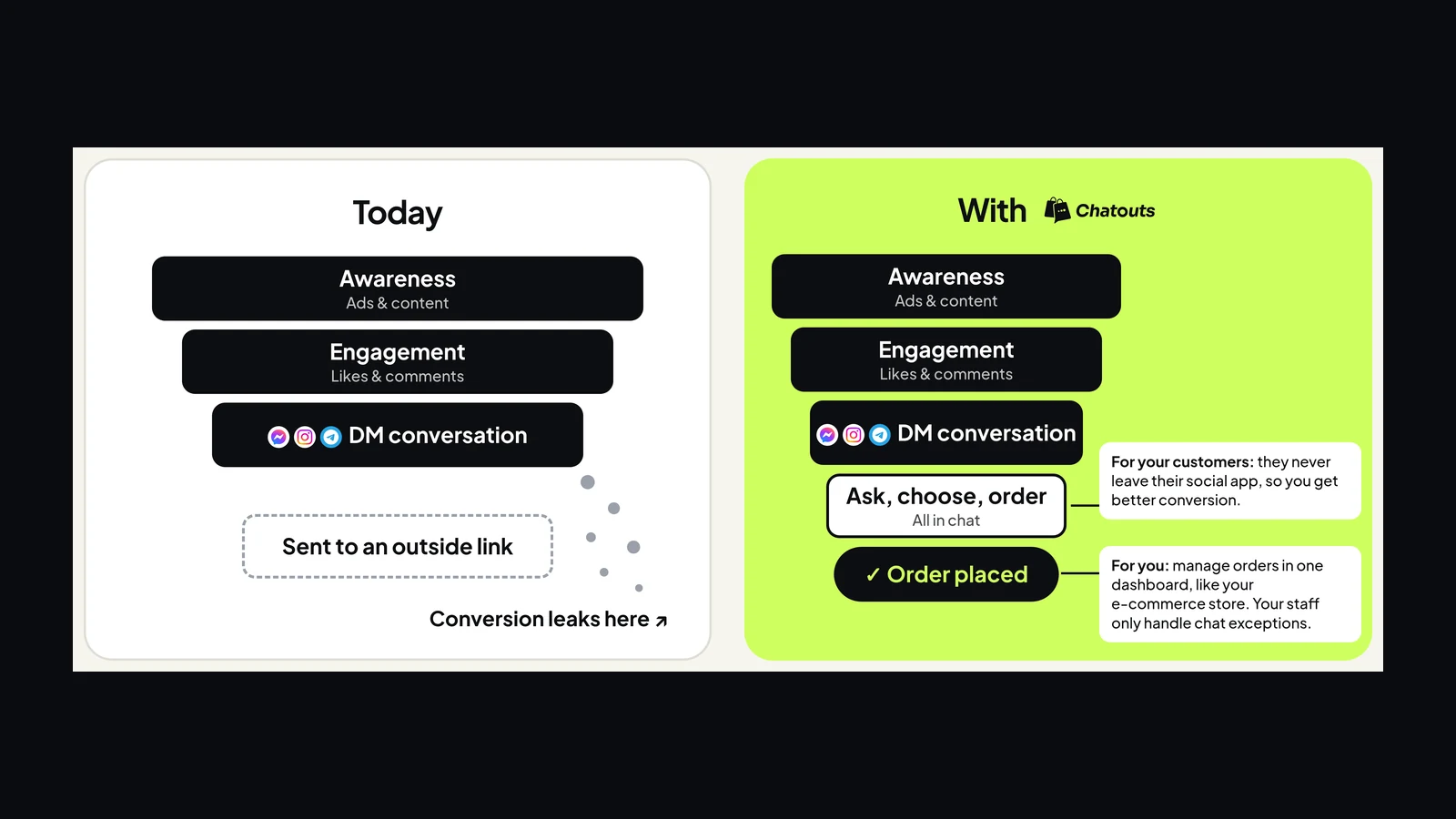
Every digital marketer knows the question:
How do we increase online sales without increasing the marketing budget?
The answers are familiar. Improve the creative. Improve targeting. Improve the offer. Optimize landing pages. Improve product-page experience. Reduce cart abandonment. Simplify checkout. Strengthen retargeting. Improve the overall e-commerce funnel.
All of these are valid. They are fundamental disciplines of conversion rate optimization.
But there is another level of thinking that is often overlooked:
What if we don't just optimize each step of the funnel? What if we remove some of the steps entirely?
That question leads to a different perspective on conversion. Instead of only optimizing the funnel we already have, we can start questioning the architecture of the funnel itself.
Every Step in a Funnel Is a Potential Friction Point
Consider a familiar online sales journey:
As marketers, we naturally assign a conversion rate to every stage — clicks, product-page visits, add-to-cart, checkout starts, and completed purchases — then optimize each one.
This is good marketing. But there is a mathematical reality underneath every funnel:
Every additional step creates another opportunity for conversion to decline.
Even when every individual stage performs reasonably well, the conversion rates compound across the entire journey.
90% × 90% × 90% × 90% = 65.6%
The point isn't the exact number. The point is that friction accumulates.
So when we see a conversion drop at a particular stage, our first instinct is usually: “How can we optimize this step?” But there is another question that can sometimes be even more powerful:
Why does this step exist in the first place?
The Best Friction May Be No Friction
Modern digital commerce has spent years removing unnecessary friction — fewer form fields, autofill, remembered customer information, simplified navigation, one-click or accelerated payment, better mobile checkout, and guest checkout.
Why? Because every unnecessary action consumes attention and creates another opportunity for abandonment.
Average global cart abandonment (Baymard Institute)
Checkout usability, complexity, and forced account creation remain major friction sources
Source: Baymard Institute cart abandonment research
Conversion optimization isn't only about making each step better. Sometimes it is about removing the need for the step altogether.
That principle becomes particularly interesting when we look at social commerce.
The Social Commerce Funnel Has an Architectural Problem
Imagine a customer discovers a product on Instagram. They are interested. They click through to the brand's website. Now they need to:
Every step can be optimized. But every step also introduces another opportunity for the customer to drop.
More importantly, the customer may already have expressed their intent before entering this journey. They might have sent the brand a message:
“How much is this?”
“Do you have this in black?”
“Which model would you recommend?”
That message is not merely customer service. It is a purchase signal.
The customer has already started talking to the brand. Yet the conventional architecture often responds by moving them into another environment: “Here is our website. Please continue there.” Why? Because the commerce infrastructure lives somewhere else.
What If We Question the Transition Itself?
This is where a different kind of conversion optimization begins. Instead of asking only how to make the social-to-website funnel convert better, ask:
What if we don't need to move this customer from social to the website at this point?
What if the customer can simply continue the conversation?
Customer: “I'm looking for a laptop for university and gaming. My budget is around $1,000.”
Customer: “Which one would you recommend?”
The AI understands the customer's needs, identifies relevant products, retrieves current product information, checks inventory, and explains the differences. The conversation continues. Then:
Customer: “Okay, I'll take the second one.”
The system collects the required information and creates the order. The customer doesn't necessarily need to leave the environment where the intent was created.
Conventional architecture
- 1 Social
- 2 Website
- 3 Product
- 4 Cart
- 5 Checkout
Conversational architecture
- 1 Social
- 2 Conversation
- 3 Commerce
This does not mean the second path is always better. It means the brand now has another conversion architecture to test.
This Is Not About Replacing E-Commerce
This distinction is essential. We are not arguing that websites or marketplaces will disappear. And we're not arguing that every purchase should happen through conversation.
A customer who knows exactly what they want may prefer a traditional product page. A customer who wants to browse hundreds of products may prefer an e-commerce store. A customer comparing marketplace prices may prefer Shopee or Lazada.
Different journeys require different experiences. The opportunity is to recognize that conversation can be another commerce surface.
Which customers, products, and moments benefit from conversation?
Conversion Optimization Has Two Levels
This leads to a distinction we believe marketers should think about more often.
Level 1: Optimize the existing funnel
- Better advertising
- Better content & targeting
- Better landing & product pages
- Better offers & retargeting
- Better checkout & payment
Level 2: Optimize the funnel architecture
- Where is intent created?
- Where does consideration happen?
- Where do customers ask questions?
- How many environment switches?
- Which steps are unnecessary?
Level 1 remains essential. Level 2 is less common: rather than optimizing the same journey indefinitely, examine whether a different journey could produce less friction.
Context Switching Is Also Friction
One form of friction that is easy to overlook is context switching.
A customer discovers a product on Instagram, becomes interested, starts a conversation, asks a question — then receives a website link. Now they must change environments, understand a new interface, find the product again, and often re-enter information they have already provided.
The customer may still want the product. But the experience has lost continuity.
Reducing friction isn't only about reducing clicks. It is also about reducing context switches, repeated actions, repeated information, new interfaces, decision resets, and cognitive effort.
The customer can stay in one continuous interaction from question to decision to transaction.
Conversation Can Preserve the Intent Marketing Created
Marketing creates awareness → interest → consideration → intent. But the traditional digital architecture can interrupt that journey: the customer messages the brand, has questions, is close to buying — then is sent somewhere else.
Conversational commerce asks: can we preserve the customer's context and intent instead of transferring them into another experience?
The customer doesn't need to stop the interaction simply because it is time to buy. And that is the core idea behind our thesis:
Conversation Makes Conversion.
Not because every conversation converts. Not because chat is always superior to a website. But because conversation can reduce the distance between intent and transaction.
Selling Has Always Been Conversational
Selling has never been purely about presenting products. A good salesperson asks questions, understands needs, handles objections, and helps the customer decide. Selling is often a conversation.
E-commerce made transactions scalable through self-service. That was transformative — but self-service is not ideal for every purchase. When customers have uncertainty or complex needs, conversation creates value. AI finally makes that conversation scalable.
So Why Isn't This Popular Among Brands Yet?
If conversation can reduce the distance between intent and purchase, why isn't conversational commerce already standard?
Because most brands still treat chat as a customer experience tool — FAQs, ticket routing, support deflection — not as a sales channel.
So when a customer says “Do you have this in black?” or “I'll take it,” the bot can often reply, but it usually cannot close the sale. Commerce still lives on the website. Intent is created in the conversation. Conversion is pushed somewhere else.
There's a second barrier: adoption itself is hard. Building those bots often requires an agency, a flow designer, or another middleman. Brands pay someone to map menus and branches — instead of configuring a store that can sell.
In short: the idea is clear, but the operating model has been wrong. Chat was set up for support. Sales stayed on the website. And the tooling sat behind specialists.
What If Setup Worked Like Running a Store?
The barrier is not “brands don't need this.” The barrier is that conversational commerce has felt like chatbot engineering.
What if it felt like running an e-commerce store instead?
- Configure the AI personality
- Add business information
- Set delivery options and shop address
- Upload and configure the catalog
No agency. No flow engineering. Just business configuration — the same way you'd set up a store.
Then the social inbox stops being only a support inbox. It becomes a commerce surface — Instagram, Messenger, WhatsApp, and other channels sitting on the same sales infrastructure.
What Chatouts Does for Brands
Chatouts is chat commerce infrastructure for brands that already create demand on social — and lose conversion when intent leaves the conversation.
- Turn messy chats into structured orders — customers talk naturally in DMs; Chatouts converts that conversation into a clean order with products, quantity, price, and customer details.
- Your team runs chat sales like e-commerce — every order lands in Sale Records Management, so staff can track, fulfill, and manage it the same way an e-commerce team runs store orders.
- 3 minutes to learn. 30 minutes to set up. — any marketer or staff member can configure catalog, delivery, and AI personality. No technical skill required — and no complex API or CRM integration project to get started.
Conversation Makes Conversion.
Chatouts turns messy social conversations into structured orders your team can operate — not tickets stuck in an inbox.
Learn in minutes. Set up in under half an hour. Let Chatouts handle the selling — and grow online sales without growing ad spend.